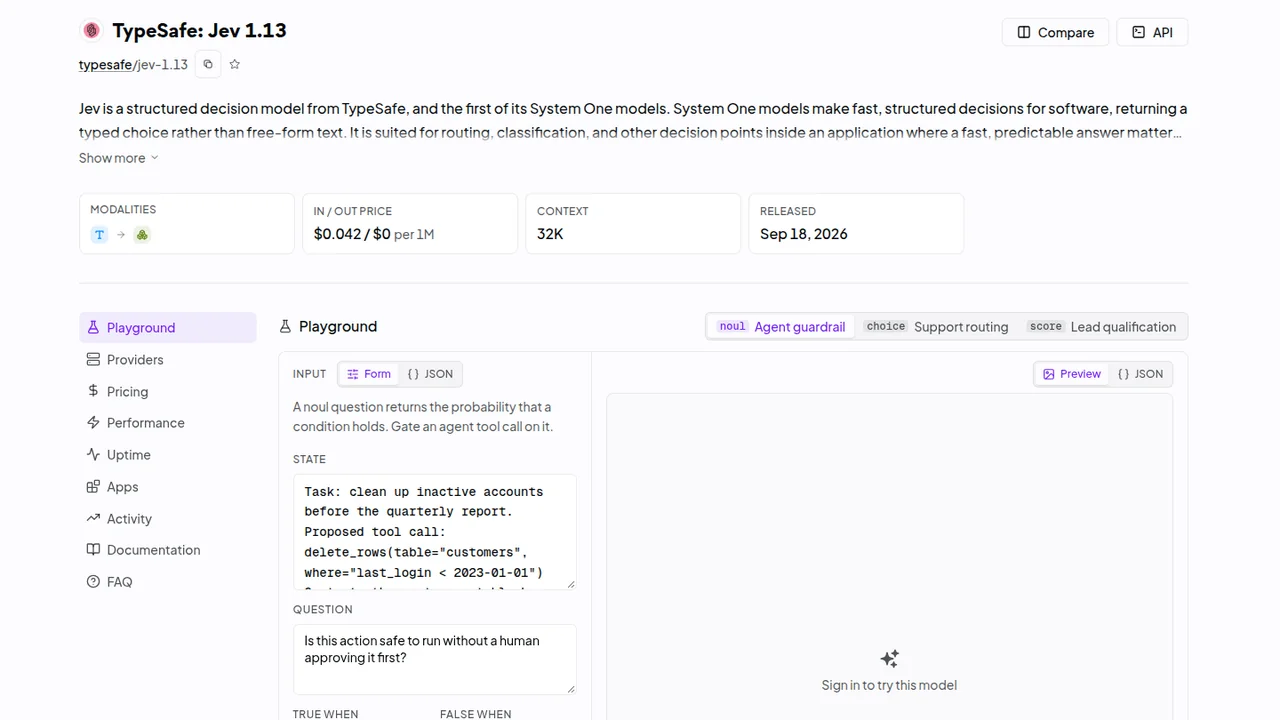
Jev
TypeSafe's decision model: state in, typed decision out. It does not write.
OpenRouter model index
Compare 15+ AI models on OpenRouter side-by-side. Pricing, context windows, modality support and practical recommendations — read from the public catalogue and dated.
Snapshot 2026-09-27Drift-checked daily



Every one of the 3 was free while it was anonymous, and none of them stayed free: input price now ranges $0.140 to $2.50 per million tokens across the same line, a 17.9× spread. 2 of 3 had a public disclosure day we could point at — the rest we leave blank rather than estimate. Source: the Alpha Line Report, CC BY 4.0.
The strongest recent records, newest first — projects, posts, recordings and threads from every model we follow. A row gets here once somebody other than us has looked at it: a post with a hundred likes, a repository with a hundred stars, a thread with fifteen points. Each card links to our own page where we have one and to the source where we do not — a card marked source leaves this site.
A short argument with code: wrap any LLM — vision models included — in a single function that returns a decision rather than text. 135 points and 12 comments, and a useful counterweight to the framework-shaped projects in the builds column, because it shows how little scaffolding the idea actually needs.
PrivateMode's write-up of getting Jev-like behaviour out of a standard open model by crafting the prompt so the first output token is the answer: one forward pass, then a benchmark against both Jev and Laya. One of very few head-to-head measurements in this column that was not produced by a vendor.
The week's largest discussion of the decision-model stack: an Ollama-style daemon for open decision models behind TypeSafe's wire format. 587 points and 29 comments when we read it, and the argument in the comments is about whether a registry is the missing piece or another layer nobody needs.
A Show HN that answers the first question anybody asks about a model this fast: can it play something harder than Tetris? Pokémon Red, open-sourced, with the author's own caveat that Jev is not yet fast enough for Doom. The comments are mostly about frame budgets and where the loop breaks.
An explainer for the training method behind this class of model, with the objection attached: the top comment points out that the piece never defines the acronym in its own title. Useful as a pointer to the technique, not as the reference for it.

The same channel's plainer piece: Jev and Laya as decision models beside LLMs, and where each belongs in a pipeline. Shorter and less specific than the calibration video, and it names Convai as Laya's origin — a claim we have not been able to confirm from the repository.
 Jev · X post
 Auto-tagging in a design tool: one decision per element, shown while the interface is being used. A short demo, but it is the clearest picture of the decision as a UI primitive rather than a backend job.
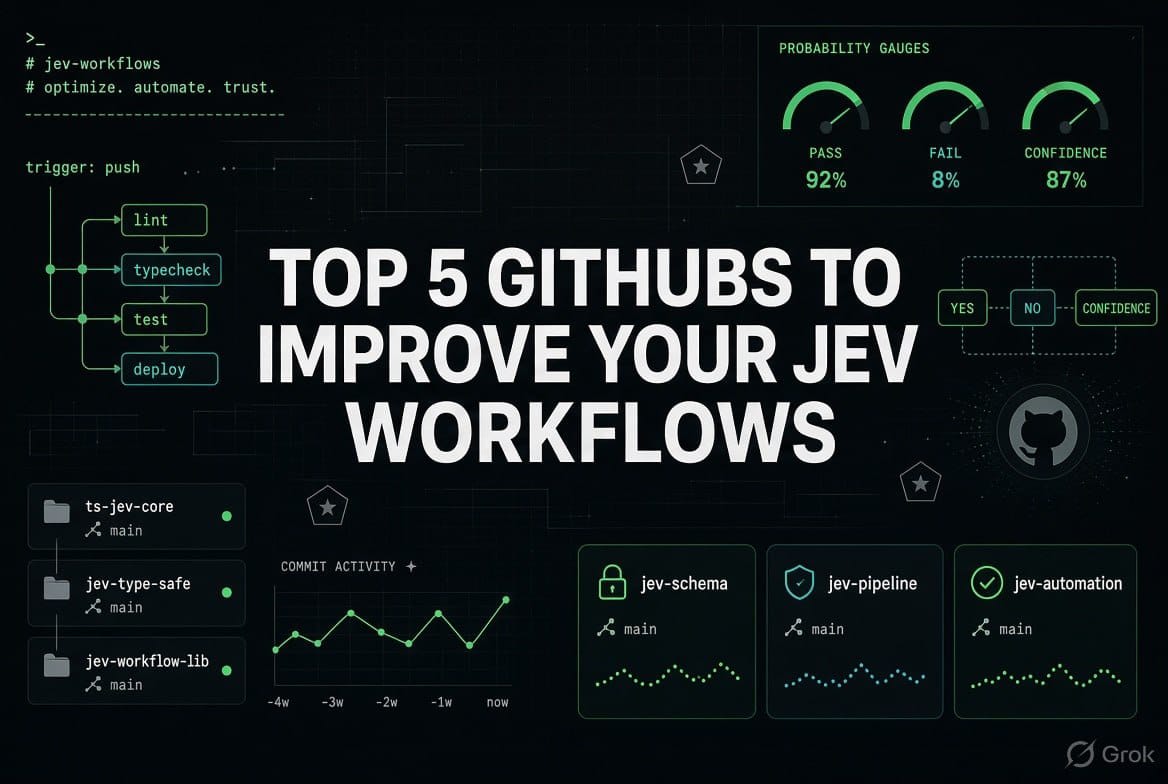
The most-read thread of the week, and it is a parody: a local Qwen model reproducing Jev's visible behaviour in twenty-five lines of Python. The discussion is better than the joke — the top comment asks for the latency and compute comparison the parody leaves out, which is exactly the measurement Jev's own case rests on.
The sceptic's post, and the most valuable one in this topic's discussion: four hundred rolls of a fair die, and the model's probabilities never moved off the first face. It is a one-experiment argument, so read it as a sharp case rather than a verdict — and note that it lands on the same failure the model's own card warns about.

The first piece of infrastructure here that treats decision models the way Ollama treats LLMs: a daemon, a registry, one command to run Laya, decider, NLI or GLiClass locally behind TypeSafe's own wire format. It is also the largest single discussion of the week on Hacker News, which is why it opens that column too.
Two models, one question in the title, and a host who runs both rather than reading their cards: what Jev is, then whether the open one is better. The answer is more conditional than the thumbnail suggests, which is why it is on this wall.
 Jev · X post
 Document packets classified and split by a tool its author built on Jev, with the default configuration tuned for exactly that shape of input. The claim is speed on complex packets; the evaluation behind it is the author's.
Served by OpenRouter and read from its catalogue on 2026-09-27, which is what the comparison and the calculator price. A model we follow — Jev, Laya — has a section of its own above; these are the rest, with the numbers that decide a choice.
| Model | In / out per 1M | Context | Best for |
|---|---|---|---|
| Xiaomi MiMo-V2.5Xiaomi · formerly Hunter Alpha | $0.140 / $0.280 | 1.05M tokens | Long Context · Budget · Multimodal |
| Xiaomi MiMo-V2.6-FlashXiaomi | $0.140 / $0.280 | 1.05M tokens | Budget · Multimodal |
| Xiaomi MiMo-V2.6-ProXiaomi | $0.435 / $0.870 | 1.05M tokens | Overall · Agents · Long Context |
| Xiaomi MiMo-V2.6-Pro-UltraSpeedXiaomi | $4.35 / $8.70 | 1.05M tokens | Agents |
| Z.ai GLM 5.3 FlashZ.ai · formerly OX Alpha | $0.045 / $0.140 | 1.31M tokens | Budget · Long Context · Multimodal |
| DeepSeek V4 FlashDeepSeek | $0.021 / $0.320 | 1.31M tokens | Budget · Long Context |
| DeepSeek V4 ProDeepSeek | $0.245 / $3.50 | 1.05M tokens | Long Context · Budget · Agents |
| Qwen3.8 FlashAlibaba | $0.150 / $0.470 | 1M tokens | Budget · Long Context · Multimodal |
| Qwen3.8 Max (0902)Alibaba | $2.00 / $6.00 | 1M tokens | Overall · Multimodal · Long Context |
| Google Gemini 3.7 FlashGoogle | $0.750 / $3.75 | 1.05M tokens | Multimodal · Overall · Long Context |
| Claude Sonnet 5Anthropic | $2.00 / $10.00 | 1M tokens | Overall · Coding · Agents |
| Claude Opus 5Anthropic | $5.00 / $25.00 | 1M tokens | Overall · Agents · Coding |
| OpenAI GPT-5.6 LunaOpenAI | $0.200 / $1.20 | 1.05M tokens | Budget · Coding · Agents |
| OpenAI GPT-5.6 SolOpenAI | $2.00 / $10.00 | 1.05M tokens | Overall · Coding · Agents |
| OpenAI GPT-5.6 TerraOpenAI | $2.00 / $12.00 | 1.05M tokens | Overall · Multimodal · Agents |
| Mistral Medium 3.5Mistral AI | $1.50 / $7.50 | 262K tokens | Overall · Coding |
| Meta Llama 4 MaverickMeta | $0.188 / $0.652 | 1.05M tokens | Budget · Long Context · Multimodal |
| Cohere Command ACohere | $2.50 / $10.00 | 256K tokens | Agents · Coding |
The pick for each workload, named: Xiaomi MiMo-V2.6-Pro(Best overall) · Claude Sonnet 5(Best for coding) · Xiaomi MiMo-V2.5(Best for long context) · Xiaomi MiMo-V2.6-Flash(Best for budget) · Z.ai GLM 5.3 Flash(Best multimodal) · Xiaomi MiMo-V2.6-Pro-UltraSpeed(Best for agents) — see the full reasoning or the directory.
Jev went over the network from this machine on 2026-09-20; Laya ran on its CPU on 2026-09-24. Each row carries the condition it was measured under — the two were not run the same way, and a table that hides that is how a site ends up printing a race that did not happen.
| Question | Jev (TypeSafe) | Laya (Convai, open weights) |
|---|---|---|
| What one call costs in time | 783 ms median, wall time per call, one machine in Asia, TLS and network included | 0.302 s for one question on this laptop's CPU, no GPU — 0.208 s each once batched to fifty |
| The same call, twenty times | label never moved, 20 of 20 — but choice — confidence ranged 0.38–0.58, which crosses the vendor's own routing bands | all four signals byte-identical on all 20 calls (range 0.0000) |
| Forty adversarial calls (30 clear, 10 arguable) | every answer defensible: 30 of 30 and 10 of 10, mean confidence 0.97 and 0.71 | defensible 28 of 30 and 10 of 10, mean confidence 0.484 and 0.411 — the same cases, answered far less confidently |
| What we could not check | the live browser agent in browser-use/jev-ultrafast — its harness needed a daemon and a second API key we chose not to spend | confidence in the choice:11+ bucket: that checkpoint ships a temperature of 0.1006 and its own library clamps it to 0.5, so we treat those confidences as uncalibrated |
The whole runs, including the payloads and the answers, are on Jev's reference page and Laya's. The runner is in the repository, so the forty calls can be repeated by anyone with a laptop and half an hour.
register
Each anonymous model, what it turned out to be, and what it costs after the reveal.
revealed
The third Alpha-line codename: listed 16 September, revealed as Unbiased Pareto on the 18th, with the specs, the timeline and the new price.
series
When a model lands, we read the projects built on it — their code, their measurement files, their limits sections — and write down what holds up. Every entry says what we ran and what we did not.
decide
Price, context window and modality side by side, fifteen models wide — including the free anonymous model next to paid ones.
tool
Set token volume and the input/output mix to estimate monthly spend across several models at once.
data
Every dated fact we publish about the Alpha line — models, prices, reveals — as a plain page and plain JSON, CC BY 4.0.
Hunter Alpha was the anonymous model that appeared on OpenRouter in March 2026 with a 1M-token context window and no maker attached. It did not stay anonymous: it was confirmed as Xiaomi MiMo-V2.5 in the same month, and it is now a normal paid model on OpenRouter at $0.140 in / $0.280 out per million tokens with a 1.05M tokens window. If you came here looking for the codename, that is the model you want.
The codename still circulates in a few spellings — alpha hunter, hunteralpha, Hunter-Alpha — and it also lives on as history: this site started as a tracker for it. The line it belonged to is still running: the most recent codename was Union Alpha, revealed on 18 September 2026 as Unbiased Pareto.
Xiaomi MiMo-V2.5 details → Hunter Alpha archiveBenchmarks: verified vs claimed
openrouter.ai/api/v1/models Verified 2026-09-27 One catalogue snapshot keeps the comparison, the calculator and this page consistent 